Chapada Diamantina National Park x Chapada dos Veadeiros National Park in Brazil
Brazil, with its continental vastness, is home to ecological sanctuaries that are remarkable not only for their scenic beauty but also for their rich biodiversity and profound geological history. Among these national treasures, two names resonate with a special appeal for nature and adventure enthusiasts: Chapada Diamantina National Park, in the heart of Bahia, and Chapada dos Veadeiros National Park, in northeastern Goiás. Both offer an unforgettable travel experience through breathtaking landscapes, featuring monumental waterfalls, deep canyons, and vibrant biodiversity.
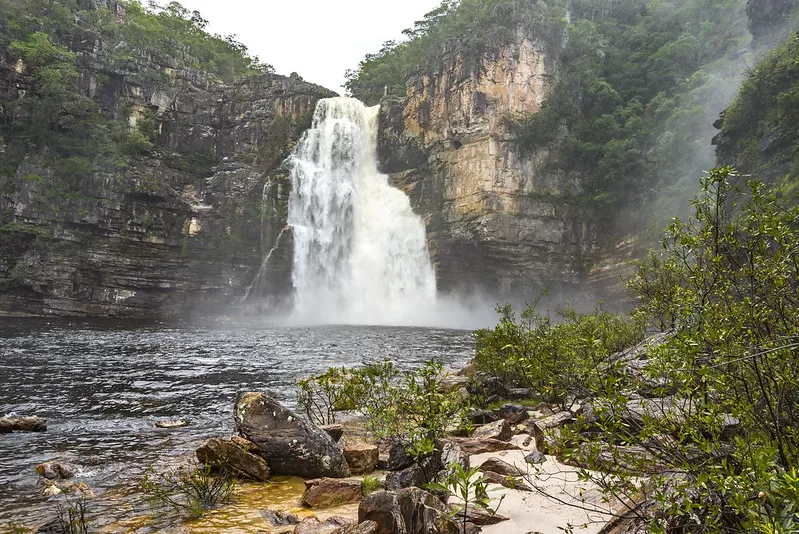
Although they share the “Chapada” (plateau) designation, these two giants possess distinct identities, shaped by different geological processes, ecosystems, and cultural influences. Choosing between them can be a challenging task. Therefore, this article provides a comparative analysis, evaluating key criteria such as size, fauna, flora, tourism infrastructure, and the optimal time to visit, in order to assist travelers in planning their next major adventure.
Origins and Scale: The Stage for the Spectacle
The first notable distinction between the two parks lies in their scale and scope. Each protects an area of immense value, but with unique characteristics and geographical distributions.
Chapada Diamantina National Park (Bahia): Established on September 17, 1985, the Chapada Diamantina National Park (PNCD) protects an area of approximately 152,000 hectares (1,520 km²). This conservation unit is located in the Sincorá Range, a section of the Espinhaço Mountain Range that extends from Minas Gerais to Bahia. The park is not a continuous, enclosed territory; its boundaries are spread across six municipalities: Lençóis, Andaraí, Mucugê, Palmeiras, Ibicoara, and Itaetê. This fragmented characteristic means that many of the most famous attractions, while part of the Chapada ecosystem, are located on private properties or in surrounding Environmental Protection Areas (APAs), such as the Marimbus-Iraquara APA. A trip through Diamantina is, therefore, an exploration of a vast region, where the national park serves as the core for the preservation of crucial ecosystems.
Chapada dos Veadeiros National Park (Goiás): In contrast, the Chapada dos Veadeiros National Park (PNCV), created on January 11, 1961, underwent a significant expansion in 2017. Originally reduced to 65,000 hectares, the park now covers a continuous area of over 240,000 hectares (2,400 km²). This expansion was a landmark for the conservation of the Cerrado, protecting one of the most emblematic and biodiverse areas of the biome. Located in northeastern Goiás, the park extends mainly across the municipalities of Alto Paraíso de Goiás, Cavalcante, Colinas do Sul, São João d’Aliança, and Teresina de Goiás. The continuous nature of its protected area facilitates management and enforcement, concentrating many of its main attractions within its official boundaries, accessible through controlled entrances.
In summary, while Chapada dos Veadeiros is distinguished by a larger, more unified protected area, Chapada Diamantina is characterized by a mosaic of conservation areas that together form a more extensive and geographically dispersed region for tourism.
Flora: The Gardens of Central Brazil
The vegetation of both plateaus is a spectacle in itself, reflecting the uniqueness of their biomes and altitudes.
Chapada Diamantina: The flora of Diamantina is a fascinating convergence of three major Brazilian biomes: Cerrado, Caatinga, and Atlantic Forest. This confluence creates unique transition zones and extraordinary botanical diversity. The landscape is dominated by campos rupestres (rupestrian fields), ecosystems that develop at altitudes above 900 meters on rocky, nutrient-poor soils. In these “rock gardens,” species adapted to extreme conditions thrive, such as everlastings (sempre-vivas), orchids, bromeliads, and species of the Velloziaceae family. It is estimated that there are more than 50 types of orchids in the region. In the lower areas, the Caatinga is present with its drought-resistant vegetation, while in humid valleys and on slopes, pockets of Atlantic Forest reveal trees that can reach 30 meters in height.
Chapada dos Veadeiros: Chapada dos Veadeiros is one of the most important refuges for the Cerrado, considered the world’s most biodiverse savanna. The predominant vegetation is high-altitude Cerrado, with 95% of this type of ecosystem on the planet located in this region. The park is home to over 1,400 of the 6,400 plant species cataloged in the biome. Trees with twisted trunks, such as the pequi, copaíba, and purple ipê, are common. The landscape is dotted with buriti palms in wetlands and bursts with the colors of ipê trees during the dry season. The local flora also includes endemic and endangered species, such as arnica and aroeira, as well as a profusion of everlastings, calliandras, and orchids.
The primary difference lies in the diversity of biomes. Diamantina offers an ecological mosaic, whereas Veadeiros provides an in-depth experience of the exuberance and uniqueness of the high-altitude Cerrado, making it a crucial point for the conservation of this biome.
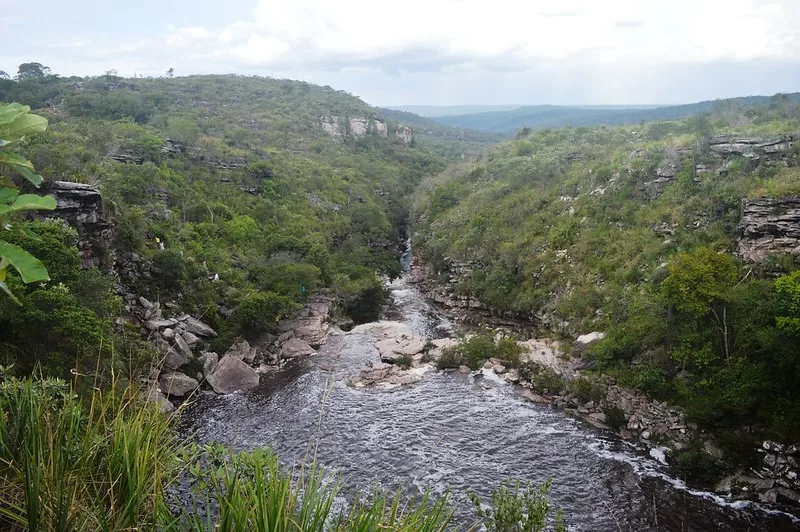
Fauna: The Wild Inhabitants
Both parks are sanctuaries for a rich and often endangered fauna, although observing large mammals is a challenge in either destination.
Chapada Diamantina: The diversity of environments in Chapada Diamantina is reflected in its fauna. The park is home to species such as the giant anteater, jaguar, cougar (puma), giant armadillo, and capybaras. However, the avifauna is particularly noteworthy, with over 300 bird species recorded. One of the highlights is the hooded visorbearer, an endemic hummingbird that inhabits the highest areas of the range. Other birds such as the potoo, caracara, and cactus parakeet can also be spotted. The region is also known for its cave-dwelling species, such as the albino blind catfish, which lives in the subterranean waters of numerous caves.
Chapada dos Veadeiros: Chapada dos Veadeiros is a vital habitat for large Cerrado mammals. About 50 of its fauna species are classified as rare, endemic, or at risk of extinction. It is one of the locations with the highest probability of sighting the maned wolf, the largest canid in South America. In addition, the park protects populations of jaguar, pampas deer, marsh deer, giant anteater, and tapir. The avifauna is also rich, featuring the rhea, king vulture, and the Brazilian merganser, one of the most threatened birds in the Americas.
In terms of fauna, Veadeiros may offer a slightly better chance of encountering emblematic Cerrado mammals, such as the maned wolf, due to its vast, continuous conservation area. Diamantina, in turn, stands out for its avifauna, especially its endemic species.
Infrastructure and Attractions: The Travel Experience
The way visitors explore each plateau is profoundly influenced by the tourism infrastructure and the layout of its attractions.
Chapada Diamantina: The travel experience in Diamantina is decentralized. The main base towns are Lençóis, Vale do Capão (a district of Palmeiras), Mucugê, and Ibicoara, each serving as a starting point for a different set of attractions. Lençóis has the best infrastructure, with an airport and a wider range of inns and restaurants. The attractions are varied, including monumental waterfalls like Fumaça (with its nearly 340-meter drop) and Buracão, pools of translucent water like Poço Azul and Poço Encantado, and cave complexes like Lapa Doce. The main highlight is the Vale do Pati trek, considered one of the most beautiful in Brazil, a multi-day trip that requires overnight stays in the homes of local residents. Access to most of the park’s attractions is free, but hiring a guide is highly recommended, as the trails are long and not always well-marked.
Chapada dos Veadeiros: The structure in Veadeiros is more concentrated. The main bases are Alto Paraíso de Goiás, the village of São Jorge, and Cavalcante. Alto Paraíso offers more urban infrastructure, while São Jorge is the official gateway to the National Park and has a more rustic charm. Cavalcante is the base for visiting the famous Santa Bárbara Waterfall, located in Kalunga territory. Inside the park, the trails are well-signposted and self-guided, which eliminates the need for a guide, although they are always a valuable source of knowledge. The main circuits in the park lead to the Saltos do Rio Preto (with falls of 80 and 120 meters), the Canyons, and the Corredeiras. Outside the park, attractions such as Vale da Lua (Valley of the Moon), Cataratas dos Couros, and Almécegas waterfalls are must-sees. Most attractions, including park entrance, require a fee.
The choice here depends on the traveler’s profile. Diamantina offers a broader and more diverse exploration, with the possibility of a long-duration trek. Veadeiros provides an experience that may be more accessible for those with less time, featuring well-structured trails and the option to visit many attractions independently.
Optimal Travel Time: Climate as a Guide
The climate is a decisive factor in making the most of what each plateau has to offer. Both destinations have two well-defined seasons: a dry season and a rainy season.
Chapada Diamantina:
- Dry Season (May to September): Considered by many to be the best time, with sunny days and little rain, ideal for hiking long trails. The nights can be cool. The water volume of the waterfalls decreases, and some, like Fumaça, may dry up.
- Rainy Season (November to March): A period of rain that fills the waterfalls, making them more voluminous and spectacular. The vegetation becomes lush and green. However, the rains can make trails difficult, and the phenomenon of “flash floods” (cabeça d’água) requires extra caution. The transitional months, such as April, May, and October, are excellent as they combine the best of both worlds: waterfalls that are still full and a lower probability of rain.
Chapada dos Veadeiros:
- Dry Season (May to September): This is the most recommended time to visit. Blue skies are almost guaranteed, and the risk of flash floods is virtually nil, making swimming in waterfalls safer. The peak of the dry season (August and September) can bring very dry air and the risk of wildfires, in addition to drastically reducing the volume of some waterfalls.
- Rainy Season (October to April): The rains restore the green to the landscape and the power to the waterfalls. December and January are the rainiest months. The main danger of this season is flash floods, which can occur suddenly and are extremely dangerous. The river waters can also become murkier. The months of April to July are considered ideal, as they mark the end of the rains, with the vegetation still green and the waterfalls full.
Which Trip is Right for You?
Ultimately, deciding between Chapada Diamantina and Chapada dos Veadeiros is a matter of personal preference and the type of travel experience one seeks.
Chapada Diamantina is the ideal choice for the traveler seeking a deep and diverse exploratory adventure. It is a destination for those with more time available and a willingness to undertake long hikes, who will be rewarded with an impressive variety of landscapes, from canyons and gigantic waterfalls to mysterious caves and the unique experience of the Vale do Pati. It is a journey that combines wild nature with the history of the diamond cycle, present in the architecture of its colonial towns.
Chapada dos Veadeiros, on the other hand, is perfect for those who desire an intense connection with the energy of the Cerrado. With its more organized structure and well-marked trails, it is an excellent destination for shorter trips or for those who prefer more autonomy. Its crystal-clear waterfalls, exotic rock formations, and the mystical aura that surrounds the region provide an invigorating journey focused on nature contemplation and well-being.
Regardless of the choice, both national parks represent the most spectacular aspects of Brazil’s natural heritage. They are destinations that invite challenge, contemplation, and, above all, a profound reconnection with nature in its purest and most magnificent form. The only certainty is that, whether in Bahia or Goiás, the trip will be unforgettable.